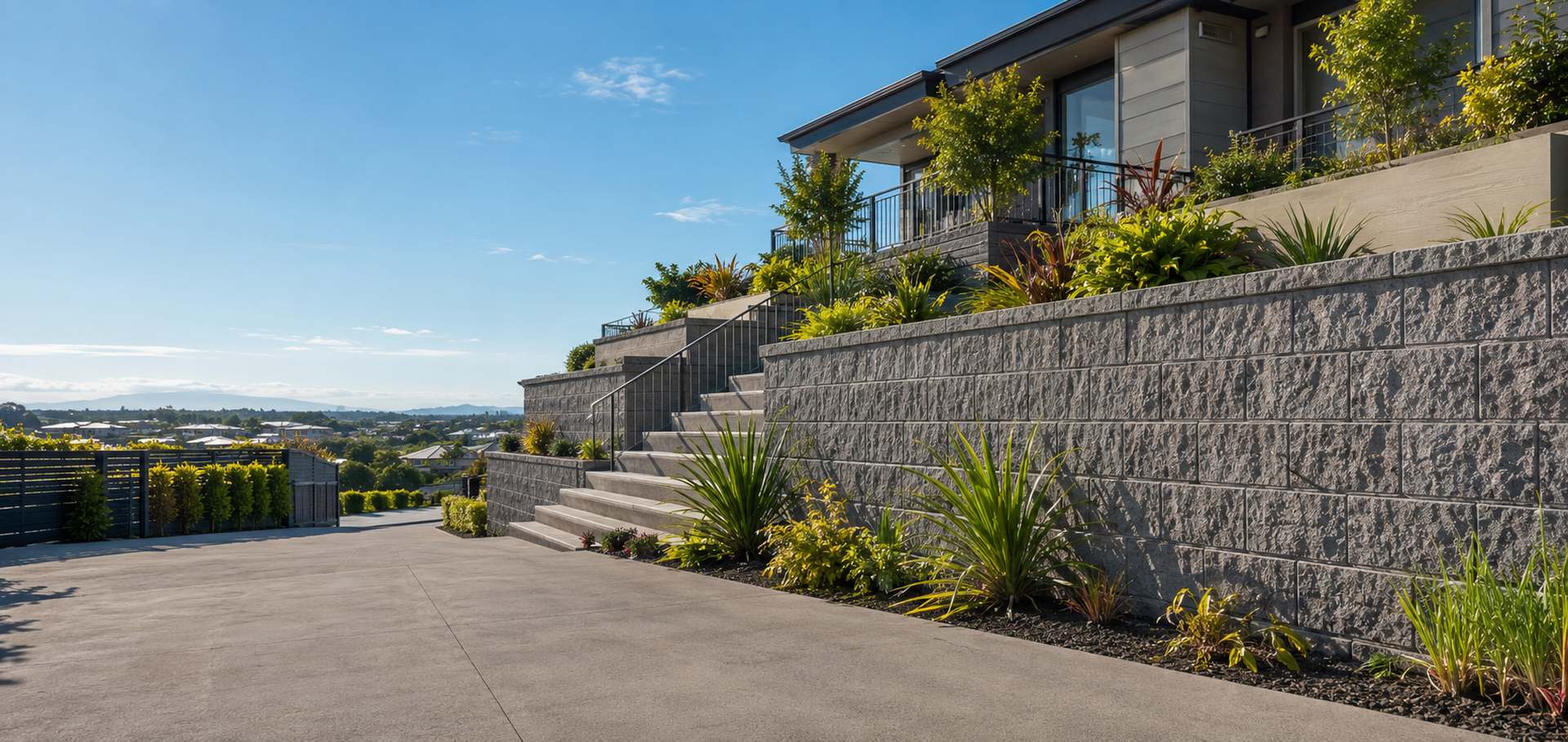
Top Retaining Walls Lower Hutt builds greywacke rock retaining walls in Lower Hutt using the stone this entire region is built from. The hills on both sides of the Hutt Valley are Mesozoic greywacke, a hard grey sandstone laid down on an ancient sea floor, and it is the single most appropriate material you can put on a Wellington section.
The stone the whole Wellington region is founded on
Hard, angular, grey, and quarried close to the valley
Stacks tight and holds a steep face
Drainage on every wall300mm of metal, a drain coil and geotextile. Never an optional extra.
H5 poles as standardThe right treatment for timber that lives in wet ground.
Consents handledHutt City, Upper Hutt and Wellington, start to finish.
Itemised quotesYou see what the drainage and the spoil actually cost.
What greywacke is and why it suits a wall
Greywacke is a tough, dense sandstone that makes up the basement rock under Wellington, Porirua, Lower Hutt and Upper Hutt. It breaks into angular blocks with flat faces, which is exactly what a dry laid or gravity wall wants, because flat faces bear on each other and lock the wall together.
Colour runs through mid to dark grey, sometimes with rusty iron staining on weathered faces. It is the colour of the hills behind your house, which is why a greywacke wall never looks imported the way pale imported stone does here.
Greywacke Rock Retaining Walls at a glance
Stone
Quarried Wellington region greywacke
Colour
Mid to dark grey, some rust staining on weathered faces
Shape
Angular with flat bearing faces
Build options
Solid stone wall, or stone facing over block or poured concrete
Batter
Holds steeper than rounded river rock
Drainage
Free draining through the voids, geotextile behind
Best for
Hill sections, bush edges and anywhere the wall should disappear
Gabion basket retaining wall filled with Wellington greywacke.
Weathered greywacke is a different material
Fresh quarried greywacke is hard rock. The weathered mantle sitting on top of it across the Wellington hills is not. Weathering turns greywacke into a yellow clay rich material that gardeners here complain about constantly, and it behaves like clay rather than like rock.
That matters twice on a hill job. It means the ground you are founding in may not be as strong as the rock underneath it, and it means water moves through it slowly, so drainage behind the wall carries more of the load.
Solid stone or stone facing over a structure
There are two ways to build. A solid greywacke wall is a genuine stone structure laid course by course, with the stone doing the retaining. A faced wall uses block or poured concrete behind with stone laid over the front.
Faced walls cost less and go higher, because the concrete does the engineering and the stone does the looking. Solid stone has a depth and irregularity a veneer never quite matches. We will show you both and let you decide.
Every wall we build gets drainage. At least 300mm of clean free draining metal,
a perforated coil at the base running to a real outlet, and geotextile over the top so silt cannot block it.
It is not an optional line on our quotes.
Common questions
Questions about greywacke rock walls
Is greywacke the same as the rock on my section?
Almost certainly. The basement rock under the whole Wellington region is greywacke. What you see near the surface on a hill section is usually its weathered clay form.
Is greywacke good for gabion baskets?
Yes, it is one of the better rocks for gabions because it is hard and angular so the pieces lock inside the basket.
Does it need sealing?
No. It has been sitting out in Wellington weather for a very long time already. Moss on the shaded side is normal and most owners leave it.
What people say
Reviews from Hutt Valley homeowners
★★★★★
Our old wall was rotten right through and leaning into the neighbour's place. They pulled the lot out, put proper drainage behind the new one and had it finished in three days. Swept the site clean every afternoon before they left too. Tidiest crew we have ever had here by a long way.
MMikePetone
★★★★★
They sorted the consent, which was the bit I was dreading. Dealt with the council so I never had to, and kept me in the loop the whole way through. The driveway sits right above it and has not shifted a millimetre.
TTonyUpper Hutt
★★★★★
Steep section, shocking access, and they still made it look easy. They suggested two smaller walls instead of one big one, which saved us thousands in engineering fees. The terrace in between is now my favourite part of the whole garden.
RRachelStokes Valley
Where we work
Greywacke rock walls across the Hutt Valley and Wellington