
Gabion Retaining Walls
Every other wall type fights water. You build a drainage layer, run a coil, wrap it in geotextile and hope nobody blocks the outlet in fifteen years. A gabion wall has no solid back face for water to push.
Read more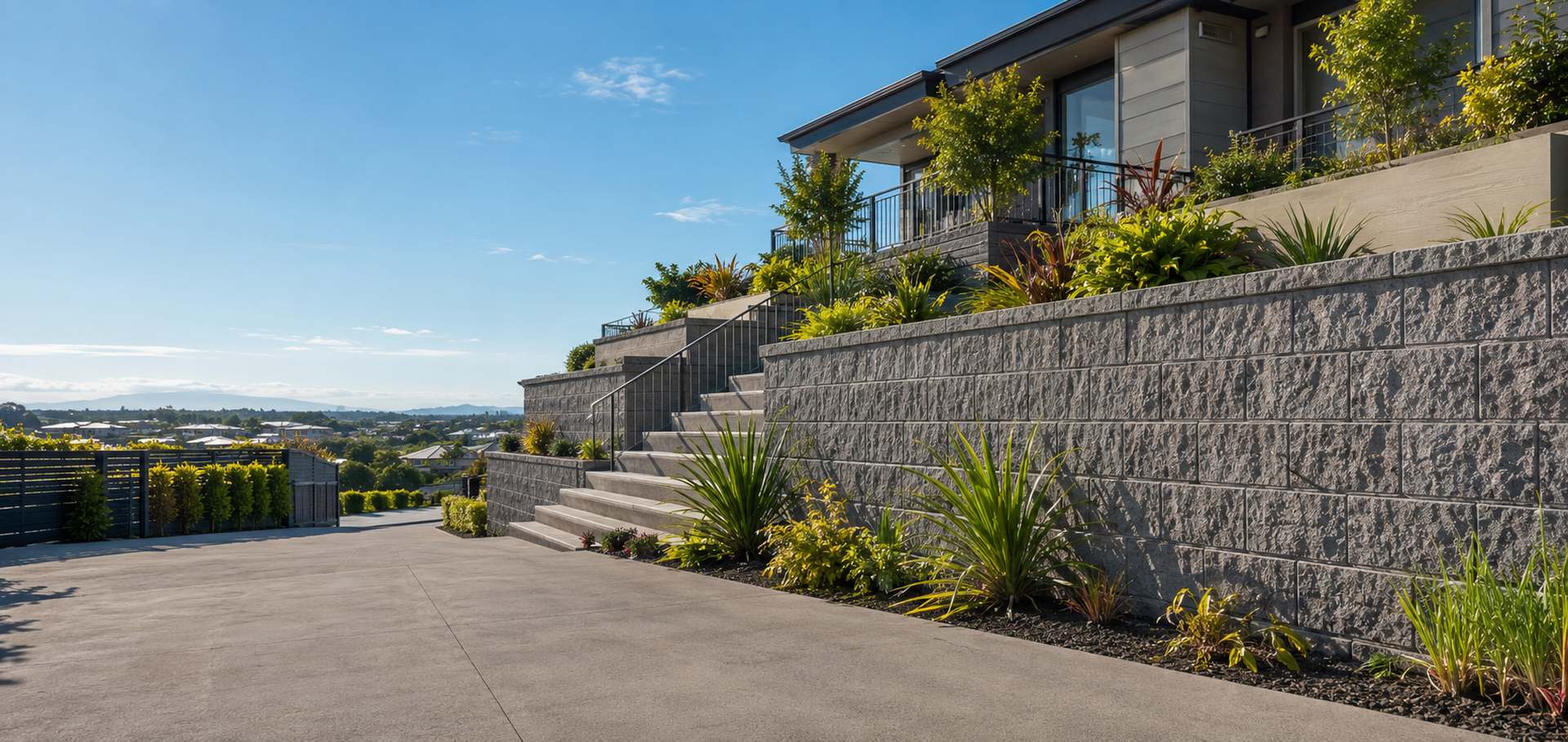
Top Retaining Walls Lower Hutt builds stone and gabion retaining walls across Lower Hutt using rock that comes out of the Wellington region. The hills on both sides of this valley are greywacke, the same hard grey sandstone the whole area is founded on, and quarried greywacke is angular, cheap to cart here and looks like it belongs on the site.
Gabions are the practical end of this category. A gabion is a galvanised or PVC coated wire basket packed with 100mm to 200mm rock, working as a gravity wall. Water runs straight through, so pressure never builds behind the face, and the basket deforms slightly instead of cracking when the ground moves. Beside an active fault, that flexibility is worth paying for.
Boulder and dry stone walls sit at the other end. They cost more per metre because a machine operator places every rock by hand, and every rock has to bear on three points of contact. What you get back is a wall with no manufactured edge on it anywhere.
Every other wall type fights water. You build a drainage layer, run a coil, wrap it in geotextile and hope nobody blocks the outlet in fifteen years. A gabion wall has no solid back face for water to push.
Read moreAn operator picks up a rock, offers it to the wall, turns it, sets it down, and often picks it straight back up to try a different face. Each boulder has to bear on three points of contact against the.
Read moreGreywacke is a tough, dense sandstone that makes up the basement rock under Wellington, Porirua, Lower Hutt and Upper Hutt. It breaks into angular blocks with flat faces, which is exactly what a dry laid.
Read moreThe wall has two faces with smaller stone packed between them, and long through stones set at intervals tying both faces into one structure. Courses lean back into the bank slightly, and each stone.
Read more
Nearly every failed wall we get called to in the Hutt Valley failed the same way. Water sat behind it, the soil got heavy, and the wall leaned out a little more each winter. So we build the drainage first and the face second.
We cover the whole Hutt Valley plus Upper Hutt and Wellington City.
We will come out, measure it and tell you straight. The site visit and the written quote are both free.