
Timber Retaining Walls
Timber does most of the work in the Hutt Valley. A pole and rail wall goes up in a few days, costs less per metre than anything else, and holds a 1.2m step in level.
See more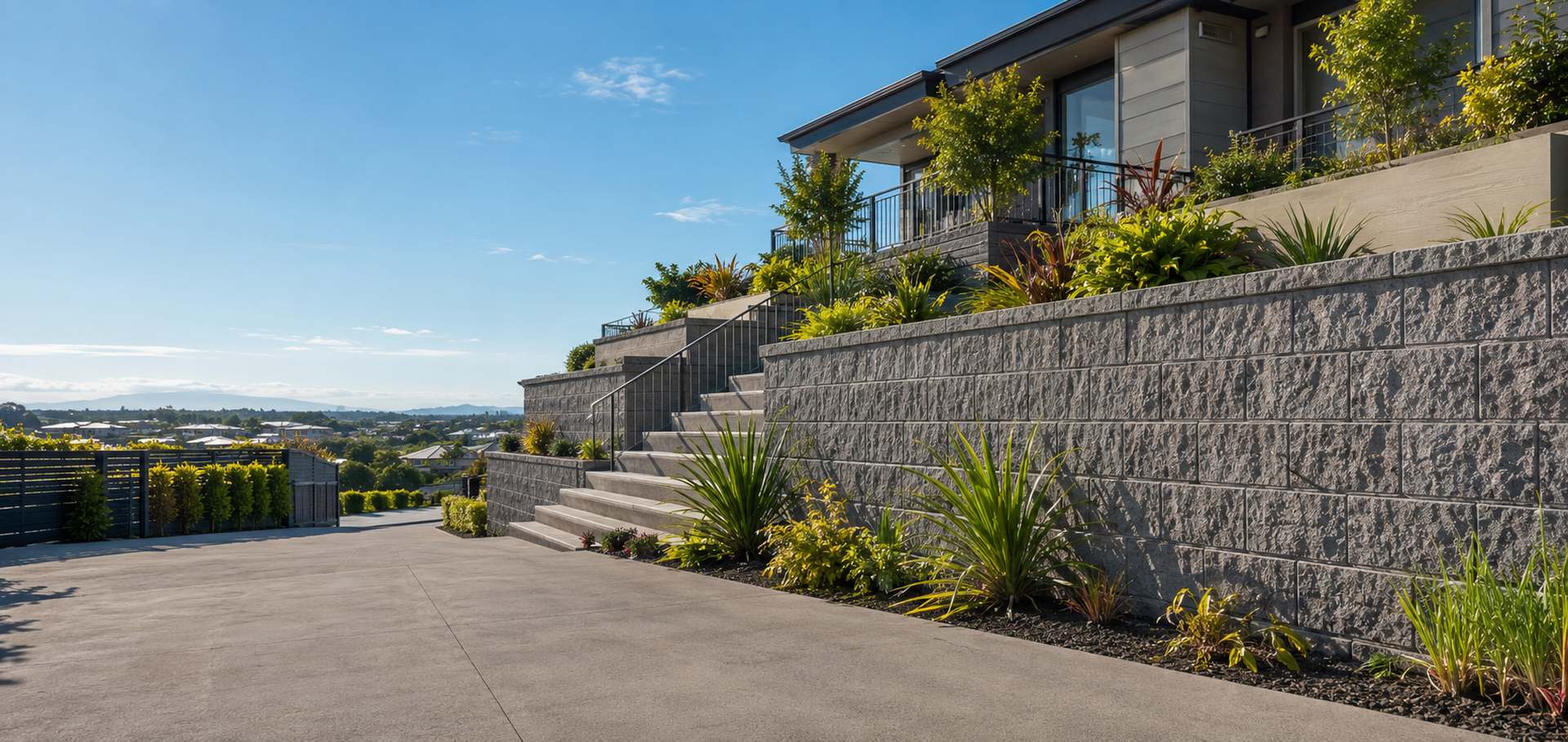
Top Retaining Walls Lower Hutt builds retaining walls in Upper Hutt, about 20 kilometres up the valley from Lower Hutt. It is a separate city with its own council, but it sits in the same fault angle basin and the ground behaves in much the same way, so the work is familiar to us.
The Wellington Fault created both the Upper and Lower Hutt basins, and both have been filled by gravel and sand carried down the Hutt River from the Tararua Range. On the Upper Hutt valley floor that means firm founding and predictable digging.
The hill margins around Totara Park, Pinehaven and Silverstream are a different story. Weathered greywacke on a slope, exactly like the Lower Hutt hill suburbs, with the same consequences for drainage and consent.
| Council for consents | Upper Hutt City Council |
|---|---|
| Typical ground | Upper Hutt basin gravels with steep hill margins |
| Walls we build most here | Timber pole and crib walls |
| Consent threshold | 1.5m of retained ground, or any surcharge above the wall |
| Drainage | 300mm metal, perforated coil, geotextile, on every wall |
| Site visit | Free, with a written quote to follow |
Upper Hutt is its own territorial authority, so a building consent for a retaining wall goes to Upper Hutt City Council rather than Hutt City. The underlying rules are identical, because they come from the Building Act rather than from the council.
What differs is the process, the fees and the people you deal with. We lodge applications with both councils regularly, so it makes no difference to you which side of the boundary your section sits on.
Upper Hutt sections tend to be more generous than the Lower Hutt average, particularly out toward Wallaceville and Te Marua. Longer wall runs with decent machine access are the cheapest metres we build, because setup spreads across more of them.
Crib walls and gabions also become practical out here, since both need a footprint that tighter urban sections cannot give up.
Not sure whether your wall needs a consent? Send us a photo and a rough height. Under 1.5m of retained ground with nothing loading it from above is exempt. A driveway, a building, a pool or fill sloping up behind it is a surcharge, and that changes the answer.
Yes, regularly. It is about 20 kilometres up the valley and well inside our normal work area.
The core rules come from the Building Act so they match. Upper Hutt City Council processes the consent and sets its own fees.
Timber does most of the work in the Hutt Valley. A pole and rail wall goes up in a few days, costs less per metre than anything else, and holds a 1.2m step in level.
See more
Concrete goes in wherever something heavy sits above the wall, and in a city built beside an active fault it is also what engineers reach for first. We build.
See more
Past 1.5m, or once a driveway or building sits above it, the job changes completely. You need a chartered engineer, a building consent from Hutt City Council and.
See more
Stone suits the Hutt hills, where a hard manufactured face can look wrong against bush and rock. The whole region is founded on greywacke, so local quarries put out.
See moreAnswer three quick questions or call [PHONE] and we will book a free site visit.